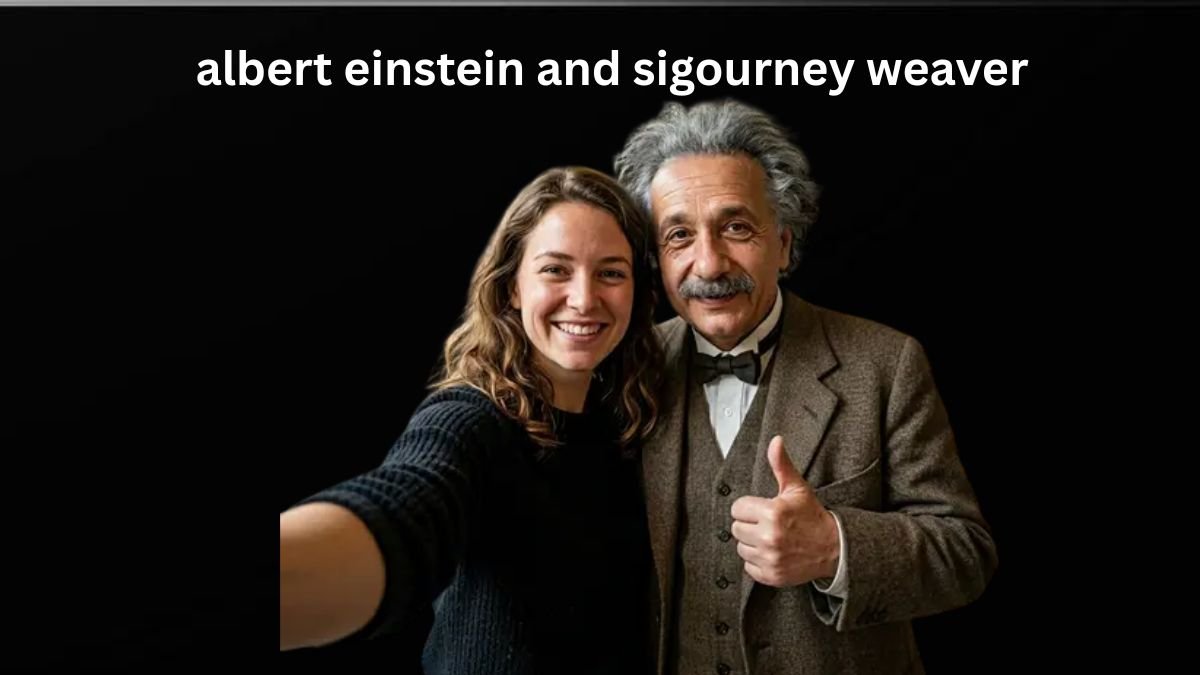
The names Albert Einstein and Sigourney Weaver belong to completely different fields, yet both have become recognizable figures in global culture. Einstein transformed modern science with ideas that changed how people understand space, time, gravity, and energy. Weaver became one of Hollywood’s most respected actors, particularly through memorable performances in science-fiction and dramatic films.
At first glance, there does not seem to be much connecting a theoretical physicist born in 1879 with an actress born more than seven decades later. Einstein was known for equations, scientific theories, and his distinctive public image. Weaver is known for acting, storytelling, and characters that became part of popular cinema. Still, the pairing of their names is interesting because both have influenced the way the public thinks about science, intelligence, and the possibilities of the future.
Who Was Albert Einstein?
Albert Einstein was born on March 14, 1879, in Ulm, in the German Empire. He later became one of the most influential physicists in history. His work changed fundamental ideas about physics, especially the relationship between space, time, matter, and energy.
Einstein became internationally famous after developing the theory of relativity. His 1905 work on special relativity introduced ideas that challenged traditional assumptions about time and motion. The famous equation E = mc² became one of the best-known formulas in science.
His scientific career continued for decades. In 1915, he presented the general theory of relativity, which offered a new description of gravity. Rather than treating gravity simply as a force between objects, the theory described gravity through the curvature of spacetime.
Einstein also became a major public figure. Newspapers frequently covered his opinions, appearances, and distinctive personality. His image eventually became almost as recognizable as his scientific achievements, making him an unusual example of a scientist who became a worldwide cultural icon.
Who Is Sigourney Weaver?
Sigourney Weaver was born Susan Alexandra Weaver on October 8, 1949, in New York City. She developed an acting career that eventually made her one of the most recognizable performers associated with science-fiction cinema.
Her breakthrough came with the 1979 film Alien, directed by Ridley Scott. Weaver played Ellen Ripley, a character who became one of the defining figures of modern science-fiction cinema. Ripley was not presented simply as a traditional action hero. The character developed through intelligence, determination, survival skills, and emotional strength.
Weaver later returned to the role in Aliens, directed by James Cameron. The film expanded Ripley’s story and gave Weaver an even larger platform to demonstrate her acting range. Her performance earned her an Academy Award nomination for Best Actress.
Outside science fiction, Weaver has worked across comedy, drama, adventure, and other genres. Her filmography includes Ghostbusters, Gorillas in the Mist, Working Girl, The Ice Storm, and the Avatar franchise.
Why Are Albert Einstein and Sigourney Weaver Mentioned Together?
The connection between Albert Einstein and Sigourney Weaver is primarily cultural rather than personal. They did not belong to the same generation, and there is no well-established historical relationship between them.
Einstein died in 1955, when Weaver was still a child. Weaver was born in 1949, meaning that the two figures technically lived during the same period for several years, but their lives and careers followed very different paths.
The reason the names can appear together is often related to their shared association with science and science fiction. Einstein represents real scientific discovery, while Weaver has portrayed characters and appeared in stories dealing with futuristic technology, extraterrestrial life, and scientific ideas.
That distinction matters. Einstein’s theories belong to the history of actual physics, while Weaver’s connection to science is largely through entertainment and popular culture.
Einstein’s Influence on Popular Culture
Einstein’s influence went far beyond universities and research laboratories. His theories became part of popular culture, even when many people encountered them without studying the mathematics behind them.
His name is frequently used as a symbol of exceptional intelligence. In everyday language, calling someone an “Einstein” can suggest that the person is extremely clever. His hairstyle, mustache, photographs, and relaxed appearance have also become instantly recognizable cultural symbols.
Movies, television programs, books, advertisements, and educational materials have repeatedly referenced Einstein. His theories have also inspired generations of writers and filmmakers who explore concepts involving time, space, gravity, and the nature of reality.
This cultural influence helped establish a bridge between scientific ideas and mainstream entertainment. That bridge is relevant when discussing Sigourney Weaver because much of her most famous work has occupied a similar space between scientific concepts and fictional storytelling.
Sigourney Weaver and the World of Science Fiction
Sigourney Weaver’s career is strongly connected to science fiction, particularly because of the importance of Ellen Ripley. The Alien series introduced audiences to a futuristic setting involving spacecraft, advanced technology, corporate interests, and extraterrestrial life.
Ripley became important because she was portrayed as a capable human being facing an extraordinary situation. Her decisions often depend on observation, experience, and practical judgment rather than simply physical strength.
Weaver’s portrayal helped demonstrate that science-fiction stories could support complex character development. The films were not only about futuristic technology or alien creatures. They also explored fear, survival, corporate power, human relationships, and ethical questions.
Her work therefore contributed to the broader cultural conversation surrounding science and technology. While her films are fictional, they have encouraged audiences to imagine how humans might behave when confronted with technologies or life forms beyond ordinary experience.
The Difference Between Einstein’s Science and Weaver’s Fiction
One of the most important points about Albert Einstein and Sigourney Weaver is that their contributions should not be confused. Einstein worked with scientific theories that could be tested, analyzed, and debated through scientific methods.
Weaver, by contrast, works in storytelling. When she appears in a science-fiction film, the technology and situations belong to a fictional universe created by writers, directors, designers, and actors.
Science fiction can certainly be inspired by real science. However, entertainment often takes scientific concepts and imagines possibilities beyond what is currently established. That creative process is different from scientific research.
This difference does not make one field more important than the other. Science attempts to explain how the natural world works, while fiction can explore questions about what might happen if certain possibilities became real. The two fields often influence each other.
Einstein’s Ideas and Science Fiction
Einstein’s theories have provided inspiration for generations of science-fiction writers and filmmakers. Concepts involving relativity, time dilation, high-speed travel, and the structure of the universe have become recurring themes in speculative storytelling.
Special relativity, for example, shows that measurements of time and space depend on an observer’s state of motion. This idea can sound strange when first encountered, but it has been supported by extensive experimental evidence.
Science fiction often takes such ideas and asks imaginative questions. What would happen if humans could travel extremely close to the speed of light? How would travelers experience time compared with people who remained on Earth? Could humanity ever travel between distant star systems?
These questions belong to speculative storytelling when presented as fictional possibilities. Einstein’s actual theories provide the scientific foundation that can make some of those stories more intellectually interesting.
Sigourney Weaver’s Broader Career
Although Sigourney Weaver is closely associated with science fiction, limiting her career to that genre would overlook much of her work.
She has appeared in comedies such as Ghostbusters, where she played Dana Barrett. She also received critical recognition for her dramatic performances, including her role in Gorillas in the Mist, for which she earned an Academy Award nomination.
Her performance in Working Girl also demonstrated her ability to work successfully in a very different kind of story. The film combined workplace themes, comedy, romance, and drama.
Weaver later became part of James Cameron’s Avatar universe. Her involvement in that franchise once again connected her career with large-scale science-fiction storytelling and advanced visual effects.
Her ability to move between genres is one reason she has remained an important figure in film for decades.
Einstein as a Symbol of Intelligence
Einstein’s public image has become so powerful that his name sometimes overshadows the complexity of his actual work. Many people recognize E = mc² without knowing the scientific context in which the equation appears.
His image represents curiosity, creativity, and intellectual exploration. However, Einstein’s achievements were not based on intelligence alone. Scientific progress also requires mathematics, sustained research, careful reasoning, communication, and engagement with the work of other scientists.
This is another interesting point of comparison with acting. A successful actor also relies on more than natural talent. Preparation, interpretation, collaboration, discipline, and years of experience all contribute to a strong performance.
In completely different ways, both Einstein and Weaver demonstrate how individual careers can become larger cultural symbols.
Science, Imagination, and Entertainment
The relationship between science and entertainment is often more complicated than it first appears. Scientific discoveries can inspire fictional stories, while science fiction can influence how the public imagines future technologies.
Einstein’s work gave people new ways to think about the universe. Filmmakers and writers later transformed many scientific concepts into visual and narrative experiences.
Sigourney Weaver’s career shows how those ideas can reach a mass audience through cinema. A viewer watching a science-fiction film may never study relativity, astrophysics, or advanced mathematics, but the story can still encourage curiosity about those subjects.
That does not mean entertainment should be treated as a scientific textbook. Fiction frequently takes creative liberties. Instead, its value can come from encouraging people to ask questions and explore unfamiliar possibilities.
Did Albert Einstein and Sigourney Weaver Ever Work Together?
There is no established record of Albert Einstein and Sigourney Weaver working together on a film, scientific project, or professional production.
The timeline itself explains why. Einstein died in 1955, while Weaver’s professional acting career developed many years later. Weaver became widely known during the late 1970s, particularly following the release of Alien in 1979.
Therefore, references connecting their names should generally be understood as a cultural or thematic comparison rather than evidence of a direct professional relationship.
This distinction is useful because internet searches can sometimes bring unrelated public figures together through keywords, entertainment databases, biographies, or articles discussing science and science fiction.
Their Lasting Cultural Legacy
Albert Einstein’s legacy remains deeply connected to modern physics. His theories continue to play a major role in scientific understanding, and his name remains one of the most recognizable in the history of science.
Sigourney Weaver’s legacy is rooted in cinema. Her portrayal of Ellen Ripley helped establish a memorable model for science-fiction protagonists and influenced the genre for decades.
Their legacies are therefore different but complementary in a cultural sense. Einstein represents the effort to understand the universe through scientific reasoning. Weaver represents the ability of storytelling to turn ideas about the unknown into compelling human experiences.
Both also demonstrate how specialized work can reach audiences far beyond its original field. Einstein’s research became part of everyday culture, while Weaver’s performances helped make science-fiction themes accessible to millions of moviegoers.
Final Thoughts on Albert Einstein and Sigourney Weaver
Albert Einstein and Sigourney Weaver are not connected by a documented personal or professional relationship. Instead, their names can be linked through the broader relationship between science, imagination, and popular culture.
Einstein changed scientific thinking through his revolutionary work in physics. His ideas about relativity continue to shape our understanding of space, time, gravity, and energy. Weaver, meanwhile, built a remarkable acting career and became particularly influential through science-fiction films such as Alien and Aliens.
Looking at them together highlights an interesting contrast. Einstein explored the real universe through scientific theory, while Weaver’s most famous roles helped audiences imagine fictional worlds beyond ordinary human experience.
That difference is exactly what makes the comparison interesting. One represents scientific discovery, while the other represents cinematic imagination. Together, they show how humanity can explore the unknown through both reason and storytelling.
