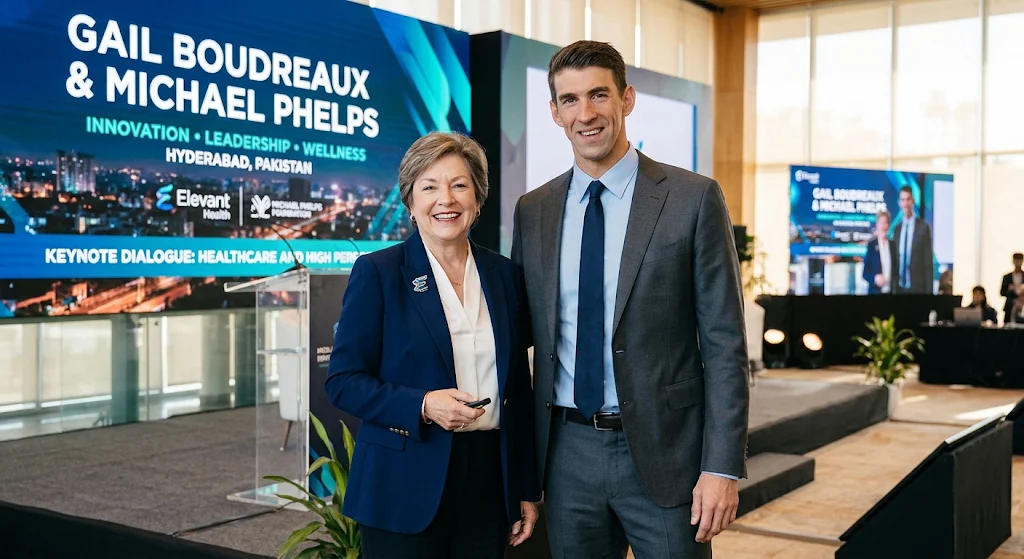
Gail Boudreaux and Michael Phelps are two remarkable American personalities whose stories demonstrate how dedication, discipline, and determination can create lasting success. Although they are known for different professional achievements, both have strong connections to the world of competitive sports. Gail Boudreaux built an impressive reputation as a basketball player before becoming one of the most influential executives in the American healthcare industry, while Michael Phelps became an international sporting icon through his extraordinary swimming career.
The keyword gail boudreaux and michael phelps brings together two individuals who have achieved success in very different environments. Their professional journeys highlight the importance of commitment, personal development, and the ability to perform under pressure. While Boudreaux is widely recognized for her leadership and business accomplishments, Phelps is celebrated for his Olympic records and contribution to competitive swimming.
However, it is important to understand that their shared appearance in this search topic does not establish a personal relationship, family connection, or professional partnership. There is no widely documented public evidence confirming a direct connection between them. Instead, their individual backgrounds provide an interesting opportunity to explore how athletic experiences can influence careers, leadership abilities, and personal achievements.
Who Is Gail Boudreaux?
Gail Koziara Boudreaux is an American business executive and former athlete who has earned recognition for her contributions to healthcare leadership. She is particularly known for serving as the president and chief executive officer of Elevance Health, one of the major health benefits companies in the United States. Her professional journey reflects years of experience in management, strategic planning, and organizational development.
Before becoming a successful business leader, Boudreaux established herself as an outstanding college athlete. She attended Dartmouth College, where she played women’s basketball and competed in track and field. Her performances on the basketball court made her one of the most accomplished players in the university’s athletic history. She demonstrated exceptional scoring ability, consistency, and determination throughout her college career.
Boudreaux’s story is interesting because she successfully transitioned from competitive sports into the corporate world. Rather than allowing her athletic career to define her entire professional identity, she used the discipline and leadership skills developed through sports as a foundation for future opportunities. Her achievements demonstrate how qualities learned during athletic competition can become valuable tools in business and executive leadership.
Gail Boudreaux’s Early Life and Educational Background
Gail Boudreaux grew up in Massachusetts, where she developed an interest in sports at an early age. Her athletic abilities became increasingly noticeable during her school years, particularly through basketball. Like many successful athletes, she spent considerable time developing her skills, improving her physical conditioning, and learning how to compete against challenging opponents.
Her educational journey eventually brought her to Dartmouth College, an institution known for its academic standards and competitive athletic programs. At Dartmouth, Boudreaux balanced her education with the demands of collegiate athletics. Managing these responsibilities required excellent time management, organization, and personal discipline, qualities that later became important throughout her professional career.
She graduated from Dartmouth in 1982 before continuing her education at Columbia Business School, where she earned an MBA with distinction. Her academic achievements provided the foundation for entering the business world. Combining an accomplished athletic background with advanced business education helped her develop a professional profile that was both unusual and impressive.
Gail Boudreaux’s Outstanding Basketball Career
Gail Boudreaux is remembered as one of the greatest basketball players in Dartmouth women’s basketball history. During her college career from 1978 to 1982, she became a four-time first-team All-Ivy selection and earned Ivy League Player of the Year recognition three times. These achievements established her as an exceptional player within the conference.
One of the most impressive aspects of her basketball career was her scoring and rebounding consistency. She finished her Dartmouth career with 1,933 points and 1,635 rebounds, remaining the university’s all-time leader in both categories according to its historical athletic records. These numbers demonstrate her ability to contribute offensively while also controlling important aspects of the game.
Boudreaux’s success was not limited to basketball. She also competed in track and field, winning four consecutive Ivy League shot put championships and one discus championship. Competing in two sports required versatility and a willingness to develop different physical abilities. Her athletic achievements eventually earned her recognition from the NCAA and several sporting organizations.
Gail Boudreaux’s Transition From Sports to Business
Moving from competitive athletics into a demanding corporate environment can be challenging. Professional sports require physical preparation, teamwork, and performance under pressure, while executive leadership involves decision-making, communication, financial management, and long-term planning. Gail Boudreaux managed to make this transition successfully.
Following her education, she entered the healthcare and insurance industries, where she gradually took on positions with greater responsibility. Her professional experience included leadership roles at Aetna, Health Care Services Corporation, and UnitedHealth Group. Each position provided opportunities to understand different aspects of healthcare operations and business management.
Her experience at UnitedHealthcare was particularly significant. She eventually became its chief executive officer, leading a major business division within UnitedHealth Group. This position involved managing a large organization serving millions of individuals. Her ability to handle complex business responsibilities helped establish her reputation as a powerful executive in the healthcare industry.
Who Is Michael Phelps?
Michael Phelps is an American former competitive swimmer widely recognized as the most decorated Olympian in history. Born on June 30, 1985, in Baltimore, Maryland, he developed an interest in swimming during childhood. His natural abilities, combined with years of demanding training, eventually transformed him into one of the most successful athletes the world has ever seen.
Phelps became internationally famous because of his extraordinary performances at the Olympic Games. Across four Olympic appearances, he won 28 medals, including 23 gold medals. His achievements established records that made him a defining figure in modern Olympic history.
Beyond his medals, Phelps became known for his versatility across multiple swimming events. He competed in freestyle, butterfly, individual medley, and relay competitions. His ability to perform at an elite level in different disciplines made him an unusually complete swimmer and helped him maintain his position among the world’s best athletes for many years.
Michael Phelps’s Early Life and Introduction to Swimming
Michael Phelps grew up in Baltimore, Maryland, alongside his family. His mother, Debbie Phelps, played an important role in supporting his education and athletic development. Swimming became part of his childhood, and he gradually discovered that he had the potential to compete at a much higher level.
During his early years, Phelps trained under coach Bob Bowman, who became one of the most influential figures in his sporting journey. Bowman recognized his abilities and helped him develop the technical skills, discipline, and mental preparation required for elite competition. Their working relationship continued for many years and became an important part of Phelps’s success.
At an age when many young athletes are still exploring different interests, Phelps was already competing at an advanced level. He qualified for the 2000 Sydney Olympic Games when he was just 15 years old. Although he did not win a medal at those Games, the experience introduced him to the demands of international competition and prepared him for future achievements.
Michael Phelps’s Historic Olympic Achievements
Michael Phelps’s Olympic career reached an extraordinary level during the 2004 Athens Games. He won six gold medals and two bronze medals, demonstrating his ability to compete successfully across several events. His performances established him as one of the leading swimmers of his generation.
However, his most remarkable Olympic achievement came during the 2008 Beijing Games. Phelps won eight gold medals, setting a record for the most gold medals won by an athlete at a single Olympic Games at that time. This performance attracted worldwide attention and became one of the most memorable moments in Olympic history.
He continued competing successfully at the 2012 London Olympics and the 2016 Rio de Janeiro Olympics. At Rio, he won five gold medals and one silver medal, adding to his already extraordinary collection. His overall Olympic record of 28 medals, including 23 golds, remains a major part of his sporting legacy.
Gail Boudreaux and Michael Phelps: Their Shared Connection to Sports
When discussing Gail Boudreaux and Michael Phelps together, their athletic backgrounds provide the clearest common ground. Both individuals demonstrated exceptional abilities in competitive sports and achieved recognition through years of dedication. Although they competed in different disciplines, their stories reveal several similarities in how successful athletes approach challenges.
Boudreaux developed her reputation through basketball and track and field, where teamwork, physical strength, consistency, and strategic thinking were essential. Phelps built his career through swimming, a sport that demands technical precision, endurance, concentration, and extraordinary physical preparation. Their respective achievements show that excellence can take different forms depending on the nature of the sport.
Another interesting similarity is the way both individuals moved beyond their initial athletic identities. Boudreaux became a leading healthcare executive, while Phelps developed interests in business, public advocacy, and mental health awareness after retiring from competitive swimming. Their experiences demonstrate that success in sports can provide a foundation for meaningful opportunities outside competition.
It is important, however, not to confuse these similarities with evidence of a direct personal relationship. Their athletic accomplishments can be discussed together without suggesting that they have worked together, share a family connection, or have an established partnership.
Leadership Lessons From Gail Boudreaux’s Career
One of the most important lessons from Gail Boudreaux’s professional journey is the value of long-term commitment. Building a successful career in a complex industry requires patience, continuous learning, and the ability to adapt to changing circumstances. Her progression through different healthcare organizations demonstrates how experience can contribute to stronger leadership abilities.
Her athletic background may also help explain her understanding of preparation and performance. Competitive basketball requires players to communicate effectively, support teammates, and make quick decisions under pressure. These abilities can be valuable in business environments, where leaders must coordinate teams and respond to unexpected challenges.
Boudreaux’s career also highlights the importance of education. Her MBA from Columbia Business School strengthened her understanding of business operations and management. By combining academic knowledge with professional experience, she developed the skills needed to lead large organizations and participate in major corporate decisions.
Michael Phelps’s Influence Beyond Competitive Swimming
Michael Phelps’s influence extends beyond the swimming pool. His performances inspired young athletes across the world and demonstrated what can be achieved through consistent preparation and determination. Many aspiring swimmers began following the sport more closely because of his international success.
Another important part of his public identity is his openness about mental health. During his career and after retirement, Phelps discussed personal challenges involving depression, anxiety, and the pressures associated with elite competition. His willingness to speak publicly about these experiences helped bring attention to mental health issues within professional sports.
Phelps has also participated in initiatives designed to support young people and promote swimming. Through the Michael Phelps Foundation, he has supported programs focused on water safety, healthy lifestyles, and opportunities for children to become involved in swimming. These activities reflect his interest in using his sporting reputation to create positive social outcomes.
His post-competition activities have also included business investments, partnerships, and media opportunities. Although his Olympic achievements remain his most recognizable accomplishments, his work outside sports demonstrates that his professional interests continue to develop.
The Importance of Discipline in Both Careers
Discipline is one of the strongest themes connecting Gail Boudreaux and Michael Phelps. Although their professional responsibilities are very different, both individuals achieved success through consistent effort and a willingness to improve. Their stories show that exceptional accomplishments rarely happen without years of preparation.
For Boudreaux, discipline was important during her college athletic career and later became valuable in executive leadership. Managing major business operations requires careful planning, attention to detail, and the ability to maintain focus even when situations become complicated. Her professional development demonstrates the importance of applying these qualities over an extended period.
For Phelps, discipline was central to almost every aspect of his swimming career. Elite swimmers follow demanding training schedules, work continuously on technique, and maintain physical conditioning throughout the competitive season. Phelps’s achievements required an extraordinary commitment to improving even when he was already considered the world’s best swimmer.
Their experiences also illustrate that discipline is not limited to physical training. It can involve education, professional development, personal responsibility, and the willingness to learn from setbacks. These principles are relevant to people pursuing careers in almost any industry.
Recognition and Awards Received by Gail Boudreaux and Michael Phelps
Gail Boudreaux has received significant recognition for both her athletic and professional achievements. During her college years, she earned multiple Ivy League honors and established impressive records at Dartmouth. Her contributions to sports were recognized through awards such as the NCAA Silver Anniversary Award and the Billie Jean King Leadership Award.
Her business accomplishments have also attracted considerable attention. She has appeared on prominent lists recognizing influential women in American business and international leadership. Her position at Elevance Health further strengthened her reputation as an important figure within the healthcare industry.
Michael Phelps, meanwhile, has received international recognition through Olympic medals, world records, and numerous swimming awards. His 23 Olympic gold medals alone represent an extraordinary achievement in the history of competitive sports. He has also received recognition from sporting organizations and institutions for his contribution to swimming.
Although their awards come from different fields, both individuals demonstrate how consistent performance can create a lasting reputation. Their achievements also show that recognition can follow people beyond their original professional environments.
Gail Boudreaux’s Influence on Women in Business and Sports
Gail Boudreaux’s career provides an important example of how women can build successful professional identities across traditionally competitive industries. Her achievements in basketball established her as a respected athlete, while her later leadership positions demonstrated her ability to succeed in large corporate organizations.
Her experience is particularly meaningful because she reached senior executive positions in an industry involving complicated regulations, financial decisions, and large-scale operations. Leading a healthcare organization requires more than business knowledge. It also involves understanding customer needs, organizational responsibilities, and the challenges faced by communities.
Boudreaux’s story can encourage young women to consider careers that combine their interests in sports, education, business, and leadership. Her journey demonstrates that an athletic background does not have to limit someone’s professional direction. Instead, it can provide valuable experience that supports future opportunities.
Her involvement with Dartmouth and recognition from sports organizations also highlight the importance of maintaining connections with educational and athletic communities. These relationships can help future generations access encouragement, mentorship, and opportunities for development.
Michael Phelps’s Legacy for Future Generations
Michael Phelps has created a sporting legacy that will remain important for generations of swimmers. His Olympic accomplishments changed expectations about what one athlete could achieve across multiple swimming disciplines. His performances also helped increase international interest in competitive swimming.
For younger athletes, his career provides an example of the importance of setting ambitious goals. However, his story also demonstrates that success involves more than winning medals. Training, teamwork, personal development, and the ability to manage difficult moments are all important parts of becoming a successful athlete.
His public conversations about mental health have added another dimension to his legacy. Professional athletes often face enormous expectations from fans, sponsors, coaches, and themselves. By discussing personal struggles, Phelps has encouraged broader conversations about the importance of emotional well-being.
His foundation and other public initiatives further demonstrate his interest in supporting the next generation. Through water safety and swimming programs, he has helped connect his sporting experience with practical opportunities for young people.
Are Gail Boudreaux and Michael Phelps Related?
One question that may arise when people search for Gail Boudreaux and Michael Phelps is whether the two individuals share a family relationship. Based on publicly available biographical information, there is no established evidence confirming that they are related.
Gail Boudreaux is married to Terry Boudreaux, while Michael Phelps is married to Nicole Johnson. Their publicly documented family backgrounds are separate, and neither individual’s established biography identifies a family connection between them.
It is also important to distinguish between professional similarities and personal relationships. Both individuals have achieved remarkable things in sports, but this common background does not mean they are relatives, close friends, or business partners.
People frequently search for combinations of public figures because they share an interest, professional background, or recognizable achievement. In this case, their athletic histories provide a reasonable basis for discussing them together, even though a direct relationship has not been established in reliable public records.
What Makes Their Stories Interesting Together?
The stories of Gail Boudreaux and Michael Phelps are interesting because they demonstrate two different paths to success. Boudreaux moved from collegiate athletics into executive leadership, while Phelps transformed extraordinary sporting ability into a lasting international reputation and a range of post-retirement activities.
Their experiences also demonstrate that athletic success is not defined by one particular sport. Basketball and swimming require different physical skills, but both demand commitment, preparation, and the ability to perform when expectations are high. Boudreaux and Phelps illustrate how these qualities can contribute to outstanding achievements.
Another important similarity is their influence beyond their original competitions. Boudreaux’s professional accomplishments have made her a prominent figure in healthcare and business, while Phelps has become an influential voice in swimming, water safety, and mental health awareness.
Looking at their journeys together offers a broader understanding of achievement. It reminds readers that a successful career can develop in unexpected directions and that the lessons learned through sports can remain valuable throughout a person’s life.
Conclusion
Gail Boudreaux and Michael Phelps represent two impressive examples of achievement, determination, and personal development. Although their professional journeys have followed different directions, both have demonstrated the value of hard work and the importance of maintaining high standards throughout their careers.
Boudreaux’s accomplishments in Dartmouth basketball and her subsequent rise to executive leadership at Elevance Health show how athletic experience and education can support success in the corporate world. Phelps’s record-breaking Olympic career and continued involvement in mental health awareness and swimming initiatives demonstrate how a sporting legacy can influence people long after retirement.
There is no publicly established personal or family relationship between Gail Boudreaux and Michael Phelps. Nevertheless, discussing their backgrounds together provides an opportunity to understand the different ways athletes can influence business, sports, and society.
Ultimately, their stories share a valuable message: success is built through preparation, consistency, resilience, and the willingness to keep developing. Whether someone is competing in a swimming pool, playing basketball, or leading a major organization, these qualities can make a lasting difference.
You May Also Read Sean Connolly and Howard Marks

One thought on “Gail Boudreaux and Michael Phelps: Exploring Their Athletic Backgrounds, Careers, Achievements, and Influence”