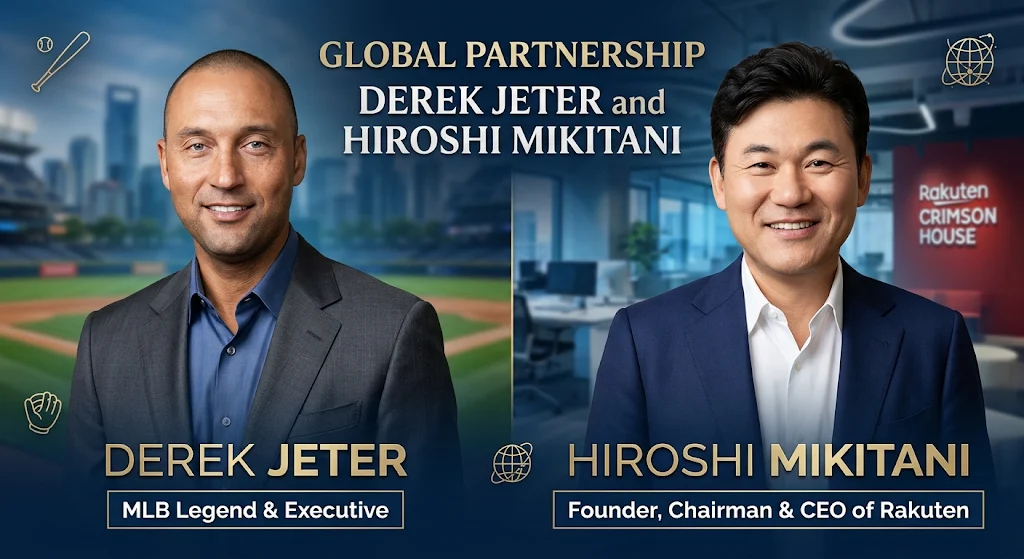
Derek Jeter and Hiroshi Mikitani are two influential figures who have made their mark in very different parts of the business and sports industries. Jeter is widely recognized as one of the greatest shortstops in Major League Baseball history, while Mikitani is known as the founder of Rakuten, one of Japan’s most recognizable technology and e-commerce companies. Although they come from different backgrounds, both have demonstrated how ambition, leadership, and a passion for sports can create opportunities that extend far beyond their original professions.
When people search for Derek Jeter and Hiroshi Mikitani, they may be curious about whether the two personalities share a professional relationship, a business connection, or a common interest in baseball. Their careers offer several interesting points of comparison. Jeter built his reputation through years of outstanding performances with the New York Yankees before entering sports management and media. Mikitani, meanwhile, transformed an entrepreneurial idea into an international business empire while investing in professional sports.
Their stories also demonstrate how sports have become an important part of modern business. Professional teams are no longer simply organizations that compete on the field. They are global brands that connect fans, companies, technology, entertainment, and communities. Understanding the careers of these two individuals provides an interesting look at the relationship between athletic achievement and business leadership.
This article explores their backgrounds, professional accomplishments, baseball involvement, business activities, and the similarities and differences that make their stories worth understanding. It also separates their documented professional connections from assumptions that have not been publicly established.
Who Is Derek Jeter?
Derek Sanderson Jeter was born on June 26, 1974, in Pequannock, New Jersey. He developed an interest in baseball at a young age and eventually became one of the most recognizable players in American professional sports. His determination, confidence, and ability to perform under pressure helped him build a remarkable career that lasted two decades.
Jeter was selected by the New York Yankees in the first round of the 1992 MLB Draft. After progressing through the minor leagues, he made his major league debut in 1995. The following season became a major turning point when he won the American League Rookie of the Year Award and helped the Yankees capture their first World Series championship since 1978.
Over the years, Jeter became the face of the Yankees organization. His consistency at shortstop, offensive contributions, and leadership qualities made him an important part of one of baseball’s most successful teams. He eventually became the team’s captain, earning the nickname “The Captain” among fans and sports commentators.
Jeter finished his playing career in 2014 with 3,465 hits, 14 All-Star selections, and five World Series championships. His accomplishments earned him a place in the Baseball Hall of Fame in 2020. His number 2 jersey was also retired by the Yankees, recognizing his extraordinary contribution to the organization.
MLB.com+1
Derek Jeter’s Journey With the New York Yankees
Derek Jeter’s relationship with the New York Yankees is one of the most important parts of his professional story. He spent his entire 20-year MLB playing career with the franchise, something that became increasingly special in an era when many professional athletes changed teams several times. His loyalty helped establish a strong connection between him and generations of Yankees supporters.
During the late 1990s, Jeter played a central role in the Yankees’ championship success. The team won the World Series in 1996, 1998, 1999, and 2000, creating a dynasty that remains an important chapter in modern baseball history. Jeter was not simply a talented individual player; he was part of a group that understood how to perform together during the most important moments of a season.
One of the defining qualities of Jeter’s playing style was his ability to deliver important performances in high-pressure situations. Whether he was making a defensive play, producing a crucial hit, or encouraging his teammates, he consistently demonstrated composure. His famous postseason performances helped strengthen his reputation as a player who could handle the biggest stages.
His final season in 2014 attracted enormous attention from baseball fans. Supporters across the country celebrated his career and recognized the impact he had made on the sport. Although retirement ended his playing days, it did not end his involvement in baseball or business.
Who Is Hiroshi Mikitani?
Hiroshi Mikitani is a Japanese entrepreneur and business executive best known for founding Rakuten Group. Born on March 11, 1965, in Kobe, Japan, he developed an interest in business and economics before eventually becoming one of the country’s most influential technology entrepreneurs.
Mikitani studied at Hitotsubashi University and later earned an MBA from Harvard Business School in 1993. Before becoming an entrepreneur, he worked at the Industrial Bank of Japan. His professional experience in finance gave him an understanding of business operations, investment, and economic development.
In 1997, Mikitani founded Rakuten with the ambition of creating an online marketplace that would help businesses reach customers through the internet. At the time, online shopping was still developing, and many traditional companies were uncertain about the future of digital commerce. Mikitani believed that the internet could create new opportunities for merchants and consumers.
His idea gradually developed into a much larger business. Rakuten expanded into financial services, digital entertainment, telecommunications, and international operations. The company also became involved in professional sports, reflecting Mikitani’s belief that sports could play an important role in building recognizable brands and connecting with communities.
Entrepreneurship+2
How Hiroshi Mikitani Built the Rakuten Business Empire
Rakuten started as an online shopping marketplace in Japan, but Mikitani always had a broader vision for the company. Instead of limiting its services to internet retail, he wanted to create an ecosystem in which customers could access multiple services through connected platforms.
One of the company’s important business strategies was giving merchants opportunities to establish their own identities. Rather than treating every seller as an interchangeable listing, Rakuten encouraged businesses to communicate directly with customers and develop distinctive online stores. This approach helped differentiate its marketplace from more standardized shopping platforms.
As the company expanded, it entered several additional industries. Financial services, credit cards, online banking, securities, digital content, and mobile communications became important parts of its operations. These businesses helped Rakuten develop relationships with customers beyond ordinary online shopping.
International expansion also became a major priority. Mikitani understood that technology companies needed to compete in a global environment. Rakuten pursued international investments, acquisitions, and partnerships to expand its presence outside Japan. His leadership helped transform the company from a domestic internet marketplace into a diversified international business group.
The business strategy also involved developing a recognizable corporate culture. Mikitani promoted English-language communication within Rakuten to support international cooperation. This decision attracted attention because it represented a significant cultural change for a major Japanese corporation.
Entrepreneurship+1
Derek Jeter and Hiroshi Mikitani: What Connects Them?
The connection between Derek Jeter and Hiroshi Mikitani is particularly interesting because both have been involved in professional baseball, although from different positions. Jeter became famous as an athlete and later worked as a team executive. Mikitani approached baseball from the business and ownership side, using sports as part of his broader corporate strategy.
Their professional worlds have an important point of intersection through Masahiro Tanaka. Tanaka was a star pitcher for the Tohoku Rakuten Golden Eagles, a Japanese professional baseball team owned by Rakuten. After an outstanding season in Japan in 2013, he moved to Major League Baseball and signed with the New York Yankees in January 2014.
At that time, Jeter was still the Yankees’ captain and was preparing for his final MLB season. Mikitani was associated with the organization that Tanaka was leaving. This created a notable connection between the two men’s professional baseball environments, even though it does not establish that they personally negotiated or entered into a business partnership.
Tanaka’s move also demonstrated how baseball connects different countries and professional organizations. Japanese players had already established a strong presence in Major League Baseball, but his arrival attracted significant attention because of his exceptional record with the Golden Eagles. His transition brought together the interests of Japanese baseball, American baseball, and international sports business.
The important distinction is that a connection through professional teams and a player transfer should not automatically be described as a personal relationship. There is no reliable public confirmation establishing that Jeter and Mikitani have a direct family relationship or a formal business partnership with each other.
Masahiro Tanaka and the Baseball Connection
Masahiro Tanaka is an important part of the story because his career provides a clear example of how the professional paths surrounding Jeter and Mikitani intersected. Before becoming a Major League Baseball pitcher, Tanaka established himself as one of Japan’s most successful young players.
He played for the Tohoku Rakuten Golden Eagles, where his performances made him a major star in Nippon Professional Baseball. During the 2013 season, Tanaka recorded an extraordinary 24-0 regular-season record with a 1.27 earned run average. His performances helped the Golden Eagles win their first Japan Series championship.
The team’s success was particularly meaningful for Rakuten and its supporters. The organization had been established in the aftermath of the 2004 Japanese professional baseball restructuring, and winning a championship represented a significant achievement. For Mikitani, the success also demonstrated how professional sports could become an important part of a company’s identity and community involvement.
In January 2014, Tanaka joined the New York Yankees after the club secured his services through the MLB posting system. His arrival connected the Japanese baseball organization associated with Mikitani to the American team with which Jeter had spent his entire major league playing career.
Tanaka’s signing remains a useful example when explaining why Jeter and Mikitani are sometimes discussed together. Their connection is rooted in the wider baseball business environment rather than a publicly verified personal partnership.
Protect Magazine+1
Derek Jeter’s Business Career After Baseball
Retirement did not mean that Derek Jeter wanted to leave professional sports behind. Instead, he began exploring opportunities that allowed him to use his reputation, leadership experience, and understanding of athletes in different industries.
One of his most notable projects was The Players’ Tribune, which he launched in 2014. The platform was created to give professional athletes an opportunity to communicate directly with fans through personal stories, interviews, and other forms of original content. The idea was based on the belief that athletes should have more control over how their experiences and perspectives are presented.
The Players’ Tribune became an important development in sports media because it offered an alternative to traditional interviews and newspaper coverage. Athletes could explain their decisions, discuss personal experiences, and share stories in their own voices. The platform helped demonstrate that an athlete’s influence could extend into publishing and digital media.
Jeter also entered the publishing and entertainment industries. His publishing activities included children’s books and other projects, while Cap 2 Productions, launched in 2023, expanded his involvement in television and entertainment production.
Another major business opportunity came when Jeter joined the ownership group of the Miami Marlins in 2017. He became the franchise’s chief executive officer and helped oversee both its business and baseball operations. This position allowed him to experience professional baseball from the management side rather than as a player.
His time with the Marlins ended in February 2022, when he stepped down as CEO and gave up his ownership interest. Despite that departure, his experience demonstrated how a successful athlete could transition into a leadership position within a major sports organization.
MLB.com+2
Hiroshi Mikitani’s Involvement in Professional Sports
For Hiroshi Mikitani, sports have been more than a personal interest. They have also been an important part of Rakuten’s international business strategy. Through professional teams and sponsorship agreements, Mikitani has helped connect the company’s brand with sports audiences across different countries.
One of his most significant sports investments was the Tohoku Rakuten Golden Eagles. The team entered Nippon Professional Baseball in 2005 and gradually developed a strong following. Its championship victory in 2013 was an important moment for the organization and its supporters.
Mikitani also became involved in football through Vissel Kobe, a professional club based in Kobe, Japan. His involvement helped connect Rakuten with another major sporting market and created opportunities to promote the company’s brand through international football.
Rakuten’s sports activities have also included major sponsorship arrangements. One of the most recognizable examples was its partnership with FC Barcelona, which saw the Rakuten name appear on the club’s first-team shirts beginning with the 2017-18 season. The arrangement gave the company substantial international visibility among football supporters.
These activities show how Mikitani approaches sports as a combination of entertainment, community engagement, international branding, and commercial opportunity. His investments demonstrate that professional sports can help technology companies establish relationships with audiences that might otherwise be difficult to reach.
Rakuten Group, Inc.+2
Similarities Between Derek Jeter and Hiroshi Mikitani
One of the most interesting similarities between Derek Jeter and Hiroshi Mikitani is their ability to build influence beyond their original professional roles. Jeter began as a baseball player, while Mikitani started his career in banking before becoming an entrepreneur. Both eventually developed careers that reached far beyond their initial industries.
Leadership is another important similarity. Jeter demonstrated leadership through his position as the Yankees captain and later through his executive responsibilities with the Miami Marlins. Mikitani demonstrated leadership by building Rakuten and guiding its expansion into multiple business sectors.
Both personalities also understand the importance of reputation. In professional sports, a person’s public image can influence relationships with fans, sponsors, teammates, and business partners. Jeter developed a reputation for professionalism and consistency, while Mikitani established himself as an ambitious entrepreneur willing to challenge conventional business practices.
Their stories also show how important international relationships have become. Jeter’s career connected him with baseball audiences around the world, while Mikitani used Rakuten’s investments and partnerships to expand the company’s international presence. The movement of athletes between leagues, countries, and organizations creates opportunities for business leaders and sports personalities to become connected.
However, their achievements should be understood in their individual contexts. Jeter’s influence primarily comes from his sporting accomplishments and media activities, while Mikitani’s influence comes from entrepreneurship, technology, and sports ownership.
Differences Between Their Professional Careers
Although Derek Jeter and Hiroshi Mikitani share an interest in professional sports, their career journeys are quite different. Jeter built his reputation through athletic performance, discipline, and years of competing at the highest level of baseball. His professional identity developed through championships, individual achievements, and relationships with teammates and supporters.
Mikitani followed a different path. Rather than becoming a professional athlete, he developed his career through finance, entrepreneurship, and technology. His success came from identifying business opportunities, taking calculated risks, and building an organization capable of competing in international markets.
Their approaches to leadership also reflect their different experiences. Jeter’s leadership was shaped by the demands of a professional baseball clubhouse, where communication, teamwork, and performance are essential. Mikitani’s leadership has involved managing a large corporate organization, making investment decisions, developing business strategies, and navigating international competition.
Another major difference is the way their influence reaches audiences. Jeter is primarily associated with baseball fans and sports media, while Mikitani is recognized by customers, investors, entrepreneurs, and supporters of the teams connected to Rakuten. Both have achieved considerable recognition, but their professional contributions belong to different areas of modern business and entertainment.
The Role of International Baseball in Their Stories
International baseball has become increasingly important because talented players now have opportunities to compete in leagues outside their home countries. Major League Baseball has benefited from international talent, particularly from Japan, where professional baseball has a long history and a passionate following.
The movement of players such as Masahiro Tanaka demonstrates how international baseball creates relationships between teams and organizations. A successful player can become an important figure for a Japanese club before moving to the United States and introducing a new audience to his abilities.
The Rakuten Golden Eagles’ connection to Tanaka’s early professional success made the organization an important part of this international baseball story. His move to the Yankees also connected two well-known baseball organizations with different histories, business structures, and fan communities.
For Jeter, international baseball was part of the broader environment in which he played his final season. For Mikitani, it represented an opportunity to see a Japanese sports organization develop talent and gain international recognition. Their respective positions illustrate how professional baseball connects athletes, executives, owners, and supporters across national boundaries.
Derek Jeter’s Legacy in American Sports
Derek Jeter’s legacy is closely connected to the history of the New York Yankees. Few players have maintained such a long relationship with one of baseball’s most recognizable organizations while achieving so much individual and team success. His five World Series championships remain an important part of his sporting reputation.
His influence also extends beyond statistics and awards. Jeter became a recognizable example of professional discipline, preparation, and consistency. Younger players often study the careers of successful athletes to understand how they managed pressure and maintained their performance over long periods.
His charitable work is another important part of his legacy. Jeter established the Turn 2 Foundation in 1996 to encourage young people to make positive choices and pursue healthier lifestyles. The organization supports programs focused on academic achievement, leadership development, and community involvement.
His contributions have also been recognized through his induction into the Baseball Hall of Fame. That recognition reflects not only his impressive playing record but also his lasting importance to the sport. Even after retiring, Jeter continues to influence baseball through media appearances, business activities, and his connection with fans.
MLB.com+1
Hiroshi Mikitani’s Influence on Japanese Business and Sports
Hiroshi Mikitani has played an important role in changing how Japanese businesses approach digital commerce and international expansion. When Rakuten was established, online shopping was still developing in Japan. His decision to build an internet marketplace demonstrated confidence in a business model that would eventually become a major part of everyday life.
His influence is particularly visible in the way Rakuten developed relationships with customers and merchants. The company created opportunities for smaller businesses to establish online stores and reach consumers through a shared platform. This approach helped support the growth of digital commerce in Japan.
Mikitani’s sports investments have added another dimension to his professional legacy. By becoming involved with baseball and football organizations, he has connected Rakuten with major sporting communities. These investments have helped demonstrate how technology companies can use professional sports to develop their brands and establish international relationships.
His continued involvement in Rakuten’s leadership also reflects his long-term commitment to innovation. The company’s activities in financial technology, mobile communications, digital services, and sports show how his original entrepreneurial vision developed into a much broader business strategy.
Entrepreneurship+2
What Derek Jeter and Hiroshi Mikitani Teach About Leadership
The careers of Derek Jeter and Hiroshi Mikitani provide useful lessons about leadership in competitive environments. One of the most important lessons is that long-term success requires consistency. Jeter demonstrated this through his playing career, while Mikitani showed it through the development and expansion of Rakuten.
Another lesson is the importance of understanding your environment. Jeter succeeded because he understood the responsibilities of his position and the expectations associated with playing for the Yankees. Mikitani recognized the potential of online commerce when the Japanese market was still developing. Both individuals identified opportunities and worked to make the most of them.
Their stories also highlight the importance of adaptability. Jeter moved from playing baseball into publishing, entertainment, and sports management. Mikitani expanded from financial services into technology, telecommunications, and professional sports. Neither individual limited his career to the first opportunity that created success.
Finally, both demonstrate that building a lasting reputation takes time. Championships, business achievements, and public recognition are rarely the result of a single decision. They develop through years of work, strategic choices, relationships, and the ability to respond to changing circumstances.
Are Derek Jeter and Hiroshi Mikitani Business Partners?
This is an important question for anyone researching Derek Jeter and Hiroshi Mikitani. Although their professional histories have intersected through baseball, there is no clearly established public evidence that they are direct business partners or that they jointly own a company.
Their strongest documented connection is through the baseball world. Mikitani’s Rakuten organization was associated with Masahiro Tanaka before the pitcher joined the New York Yankees in 2014. Jeter was the Yankees’ captain during that period, creating a professional connection between the two organizations.
Both men have also explored business opportunities connected to sports and entertainment. Jeter developed The Players’ Tribune and became involved in the Miami Marlins, while Mikitani expanded Rakuten through professional team ownership and international sponsorships.
It is therefore reasonable to discuss them together when exploring sports entrepreneurship, international baseball, and the relationship between athletic achievement and business. However, it would be inaccurate to claim that they have a confirmed personal partnership without reliable evidence supporting that statement.
Why People Are Interested in Derek Jeter and Hiroshi Mikitani
Interest in these two personalities comes from their individual accomplishments and their connection to the wider professional sports industry. Jeter remains a popular name among baseball supporters because of his successful Yankees career, while Mikitani attracts attention through his leadership of Rakuten and his investments in professional sports.
Another reason people search for their names together is the international nature of modern baseball. Japanese players regularly attract attention in Major League Baseball, and the relationships between Japanese teams and American franchises create interesting stories for sports fans.
Their different professional backgrounds also make them an interesting comparison. One represents the athlete who successfully transitioned into business and sports management, while the other represents the entrepreneur who used business resources to become involved in professional sports.
For readers interested in sports business, their stories provide an opportunity to understand how professional athletes, team owners, technology companies, and international sporting organizations influence one another. This wider perspective makes the topic more interesting than simply comparing two famous personalities.
Conclusion
Derek Jeter and Hiroshi Mikitani have followed different professional paths, but both have become influential figures through their work in sports and business. Jeter established himself as a baseball legend through his extraordinary career with the New York Yankees before moving into sports management, media, publishing, and entertainment.
Mikitani built his reputation through entrepreneurship and the development of Rakuten. His investments in professional baseball and football demonstrate how business leaders can use sports to develop international brands, strengthen communities, and create new commercial opportunities.
Their most recognizable professional connection comes through the baseball world, particularly the relationship between Rakuten’s Tohoku Golden Eagles and the New York Yankees during Masahiro Tanaka’s move to Major League Baseball in 2014. However, there is no publicly established evidence of a direct personal or formal business partnership between Jeter and Mikitani.
Ultimately, the stories of Derek Jeter and Hiroshi Mikitani demonstrate two different ways of achieving success. One built a legacy through athletic excellence, while the other created an international business through innovation and strategic leadership. Together, their careers offer an interesting perspective on how sports and business continue to influence each other around the world.
You May Also Read Joel Greenblatt and Jim Farley

One thought on “Derek Jeter and Hiroshi Mikitani: Their Careers, Business Success, Baseball Connections, and Shared Influence on Sports”